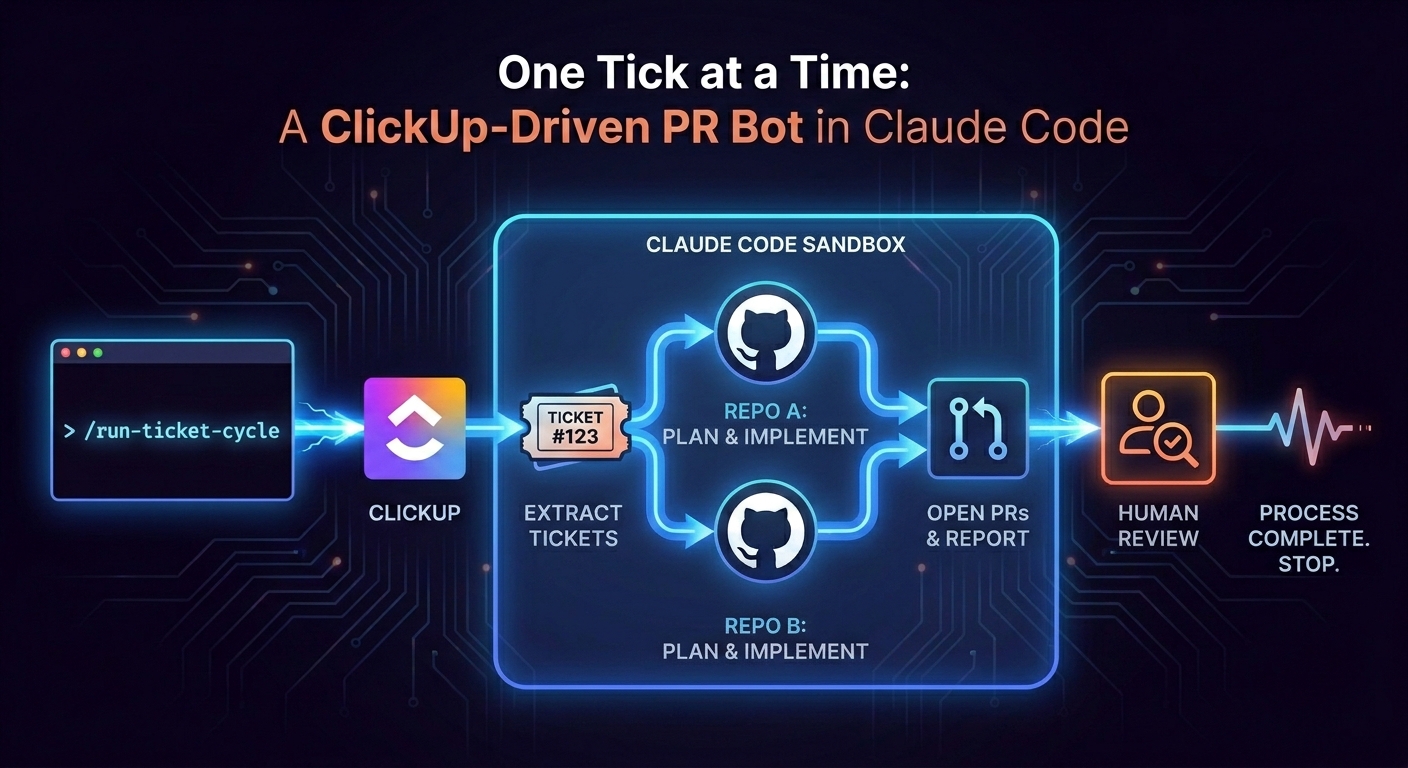
The contract is simple: add a tag in ClickUp, and Claude Code picks the ticket up. Add ten tags, it works through ten tickets. Add none, it does nothing. The slash command below implements that — it filters a ClickUp list for a trigger tag, picks the oldest eligible ticket, plans the fix before touching code, branches the repos it needs, opens PRs, writes a structured completion report back to the ticket, and then re-queries the list and does it again. It stops only when the list is empty. Pair it with the sandbox from the previous post — long-lived container, scoped GH_TOKEN, wide allowlist — and you get something that actually drains a backlog without blowing up the laptop it runs on.
The tag is the API. The loop is in the prompt. The scheduler (if any) just wakes the whole thing up.
Design constraints
- One ticket at a time, sequentially. Never process two tickets in parallel. A failure on ticket N must not leave ticket N+1 half-done.
- Claim tags are load-bearing.
claude_in_progressadded first, before any code moves. A tick that crashes mid-flight leaves the tag in place so a human sees the abandoned claim. - Re-query between tickets. Don’t snapshot the list at the top and march through it. Someone may have removed the tag to cancel, or added urgent tickets. Re-filtering makes both work.
- Hard caps. Max tickets per run, max wall-clock per run, hard-stop on any unrecoverable error. A loop without brakes is a footgun with a loop on it.
The command
Claude Code slash commands are just markdown files under ~/.claude/commands/ with a frontmatter description and a body that becomes the prompt. Here’s the loop, trimmed to the load-bearing structure:
---
description: Drain every tagged ticket from a ClickUp list — plan, branch, PR, report — one ticket at a time until the queue is empty.
---

You are running a ticket-processing loop. Process eligible tickets **one at
a time, sequentially**, until no eligible tickets remain or a stop condition
is hit. Never process two tickets in parallel.

## Fixed config (do not change)

- **ClickUp list ID:** `<LIST_ID>`
- **Required tags on a task:** `claude_code` AND `<project-tag>`
- **Skip tags (already claimed):** `claude_in_progress`, `claude_pr_opened`
- **Repo A:** `/workspace/repo-a`
- **Repo B:** `/workspace/repo-b`
- **Default PR base branch:** `<default-base>`
- **Max tickets per run:** 10
- **Hard-stop on any Error outcome** (don't try the next ticket after a failure).

## Outer loop

Repeat until one of these is true, then STOP:

- zero eligible tickets remain (print `Queue drained` and exit), OR
- you have processed 10 tickets in this run (print `Per-run cap reached`), OR
- any single ticket ended in an Error outcome (print `Stopped after error on <task-id>`).

Each iteration runs Steps 1–5 for exactly one ticket.

---

## Step 1 — Find one eligible ticket (re-query each iteration)

Call `clickup_filter_tasks` on the list *fresh every iteration* — do not
cache the list from a previous iteration. Filter tasks that have BOTH
required tags and NEITHER skip tag.

- If zero eligible: exit the outer loop with `Queue drained`.
- Otherwise pick the **oldest** by `date_created`. Store its ID as
  `$TASK_ID`. Do not pick more than one per iteration.

## Step 2 — Claim the ticket

Order matters — tag first so a concurrent run (or crash) can't double-pick.

1. Add tag `claude_in_progress` to `$TASK_ID`.
2. Move status to `in progress` (closest analog; don't abort on status failure).

## Step 3 — Read the ticket fully

Pull the full description + comments. Decide:

- **Bug or feature?** prefix = `bugfix/` or `feature/`
- **Base branch:** honor any explicit mention, else the default.
- **Branch name:** `<prefix>/<task-id>-<kebab-slug>`, slug ≤ 40 chars.

## Step 3.5 — Post the plan BEFORE touching any repo

Post a ClickUp comment with this exact structure:

    **Plan (Claude Code)**
    **Understanding:** <1–3 sentences>
    **Branch:** `<branch>` → base `<base>`
    **Repo A changes:** <bulleted list, or "No changes needed — <reason>">
    **Repo B changes:** <bulleted list, or "No changes needed — <reason>">
    **Verification:** <tests/builds per repo>

    _Remove `claude_in_progress` to cancel before this iteration finishes._

Only continue after this comment is posted successfully.

## Step 4 — Work on both repos (sequentially)

For each repo in order:

1. `cd` in, `git fetch origin`, `git checkout <base>`, `git pull --ff-only`.
2. If the plan said "No changes needed" with a solid reason, skip this repo
   entirely (no branch, no PR) — record as a clean skip.
3. Otherwise `git checkout -b <branch-name>`.
4. Implement the fix. Targeted edits only. Follow the repo's existing
   conventions. Don't add "explaining the fix" comments in code.
5. Verify: repo-appropriate lint / typecheck / tests. Fix what you broke;
   note pre-existing failures but don't fix them in this PR.
6. `git add -A` → commit `<type>: <title> (<task-id>)` → push.
7. `gh pr create --base <base> --head <branch>` with a body that links back
   to the ticket and lists a test plan.

### Failure handling inside Step 4

If any step fails (can't fix build, push rejected, `gh pr create` errors):

1. Post an `**Error (Claude Code)**` comment on the ticket with the failing
   repo, the step, and trimmed error output (~30 lines max).
2. Remove the `claude_in_progress` tag so a human / next run can retry.
3. **Hard-stop the outer loop** — do not start the next ticket. Print
   `Stopped after error on <task-id>` and exit.

## Step 5 — Close the ticket (structured completion report)

Only if Step 4 completed for both repos (or one was a clean skip):

1. Add tag `claude_pr_opened`.
2. Move status to `in review`.
3. Post a `**Done (Claude Code)**` comment with:
   - PR URLs (or "No changes needed — <reason>") for each repo
   - Branch names
   - 2–6 sentences on what actually changed and why
   - Files touched, per repo
   - Verification commands + pass/fail, per repo
   - Deviations from the Step 3.5 plan (or "None")

Return to the top of the outer loop (Step 1) for the next iteration.

## Final reminders

- **Sequential, never parallel.** One ticket must fully finish before the
  next starts.
- **Re-query each iteration.** Do not reuse the filtered list from the
  previous iteration — cancellations and new tags take effect immediately.
- **Never force-push.** Never `git reset --hard` shared branches. Never
  skip hooks.
- **Never merge the PR.** Human review is required.
- **Ambiguous ticket** → post a clarification-request comment, remove
  `claude_in_progress`, SKIP to the next iteration (not a hard stop —
  ambiguity is a per-ticket signal, not a queue-wide one).
The parts that aren’t obvious
A few design choices that look fussy on the first read but earn their keep:
- Re-query between tickets, don’t cache the list. The tag is the API. If a human removes
claude_codefrom ticket #3 between iterations, the agent must respect that on the next filter. Caching the initial list breaks the contract. - Hard-stop on error, skip on ambiguity. An error (build break, push rejected, MCP tool failure) means the bot’s execution model is broken — trying the next ticket will probably break the same way, and noise compounds. An ambiguity (conflicting comments, missing info) is a per-ticket signal — skip it and try the next one. The loop treats these differently on purpose.
- Tag-before-status, always. If tagging succeeds but status fails, the ticket is claimed and future iterations skip it — safe. If status succeeds but tagging fails, two runs could pick the same ticket — unsafe. So we tag first and tolerate status failures.
- Plan before code (Step 3.5). The plan comment is written before anything branches. This gives a human an interrupt window: remove
claude_in_progressand the current iteration (if still mid-flight) can cancel cleanly, and future iterations won’t re-pick. - Per-run cap. 10 tickets is arbitrary but finite. Without it, a queue of 200 misconfigured tickets becomes 200 error comments and a surprise API bill. Pick a number you’d be okay walking into the next morning.
- Clean skips are first-class. Lots of tickets only need work in one repo. The command explicitly supports “No changes needed —
” as an outcome, recorded in both the plan and the done comment. Without this, the agent invents busywork in the second repo to avoid looking like it failed.
Running it
The command loops internally, so no external scheduler is required — just launch once and let it drain.
# Manual: run inside the sandbox from the previous post
./sandbox/run-agent.sh
# then inside claude:
> /clickup-tick

# Non-interactive (cron / CI / scheduled wake)
./sandbox/run-agent.sh claude -p '/clickup-tick'

# Periodic wake-up for continuous draining. /loop just fires /clickup-tick
# — the loop inside the prompt does the real work; /loop handles the gap
# between "queue empty now" and "new tickets tagged later".
> /loop 30m /clickup-tick
Two scheduling styles work:
- Run-on-demand. Humans tag a batch of tickets, then kick off the command. It drains what’s there and exits. Predictable, easy to reason about cost.
- Periodic sweep. A
/loop 30m /clickup-tickor cron drives the bot every 30 min. Each wake-up: if the queue is empty it exits in seconds; if tickets are waiting it drains them. More hands-off, but you’re on the hook for whatever gets tagged in your sleep.
Both rely on the same invariant: the command itself always terminates (queue drained, per-run cap, or hard-stop on error). That’s what makes it safe to wake repeatedly.
Possible risks
Same framing as the sandbox post: blast-radius reduction, not trust-building.
When it’s working
When it’s working, tagging a ticket and walking away results in, a few minutes later, two PR links and a completion report on the ticket — and then silence if the queue is empty, or the next ticket starting if it isn’t. When it’s not working, claude_in_progress gets dropped, a clarification or error comment sits on the ticket, and the outer loop stopped cleanly. The failure mode you don’t want — a half-done PR set with no record of what happened — is the one this design is specifically built to prevent.
Quote
Make each program do one thing well. To do a new job, build afresh rather than complicate old programs by adding new features.
— Doug McIlroy, “Basics of the Unix Philosophy”